Description
Today’s entry won’t include a story focused on Red because I’m pretty busy, and I don’t want to rush it because that would ruin everyone’s experience. So for now, it’ll just be the usual description of today’s creature.
> story
Red's Dungeon Diary
Day 41: Broodblooms
The eighth floor is famed for its abundant plant life. Woven through the vast, winding labyrinth lies a dense and varied ecosystem. The maze is enormous, and no one has ever managed to chart it, its layout shifts as the dungeon itself grows and changes. Only the entrance and exit remain fixed; everything in between twists and rearranges at the dungeon’s whim, unpredictable and intricate.
Even so, explorers divide the labyrinth into several recognizable regions, each sharing certain traits:
The corridors: making up the majority of the maze, narrow paths pressed between moss-covered stone walls. Sometimes a small stream runs alongside them; sometimes they are swallowed entirely by vines and overgrown foliage.
The flower gardens: broad, open clearings hidden within the tangle, flat ground overrun by countless kinds of blossoms. Some grow close to the earth in clusters, while others tower as massive, dangerous blooms.
The marshlands: damp, sluggish terrain where movement becomes difficult. This area marks a distinct shift: plant-like creatures begin to dwindle, replaced by fauna-like beings instead. Veteran explorers know that reaching the marshlands means they are nearing the exit of the maze and stepping closer to the ninth floor, for swamps only appear near the labyrinth’s outer edges.
Inside each region of the maze lie dangers of their own. Today, we turn to the flower gardens. Within those open pockets of earth scattered across the labyrinth, countless flowers of every size, shape, and color bloom in dense clusters. Their shared trait is their intoxicating fragrance — sweet enough to lure living creatures straight into death.
A few species are far less subtle: their scent is overpowering, artificial, almost aggressive, as if they can’t be bothered to hide the trap at all.
These flowers remain poorly studied, but we do know this much — they need very little water, they do not rely on sunlight, and they consume flesh. Sometimes that means absorbing the slowly rotting corpse of an unlucky wanderer through their underground roots; other times, they hunt directly, drawing victims in with their heady perfume.
While carnivorous plants exist on the surface, the ones beneath the dungeon floor are far more dangerous. Some species can release hormones that dull the mind and bend it to their will. Others are shockingly mobile, lashing out with tendril-like limbs to seize prey and drag them into nests of thorn-sharp teeth.
But during mating season, these flowers hunt far less. Having stored all the nourishment they need, their focus shifts instead to finding hosts for their seeds. They require a warm, moist place for the sprouts to take root — and few places are more suitable than the inside of an explorer.
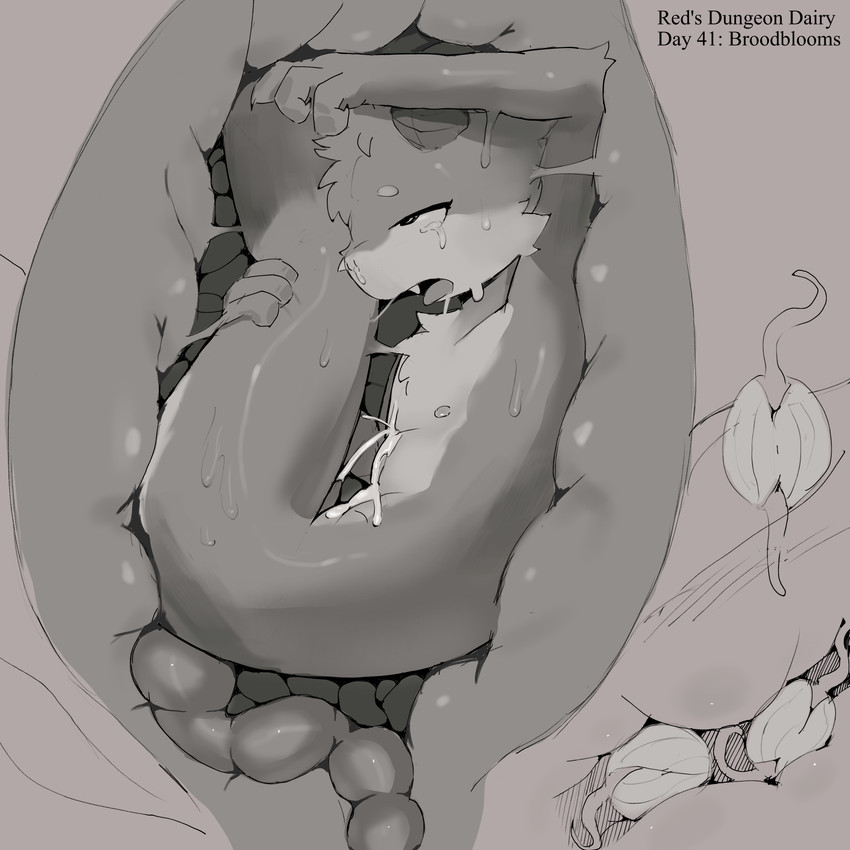
Broodblooms are the most infamous example. Each enormous blossom is lined with structures that seem almost un-plantlike, layers resembling animal muscle capable of tightening shut around a victim. A massive ovipositor handles reproduction, pumping fist-sized seeds deep into the captive's rectum.
These swollen seeds germinate quickly, clinging to anything they can once inside the warm, humid environment. After depositing all of its eggs, the bloom keeps the victim enclosed for roughly twenty-four hours, just long enough for the seeds to sprout. Throughout this period, the flower secretes a syrupy nectar, sweet like honey, allowing the host to stay alive and avoid starvation. And there’s nothing wrong with enjoying the process a little.
There are no visible comments.
Login to respond »